The Angle of Attack: Is 15 or 20 Degrees Sharper on a Knife?
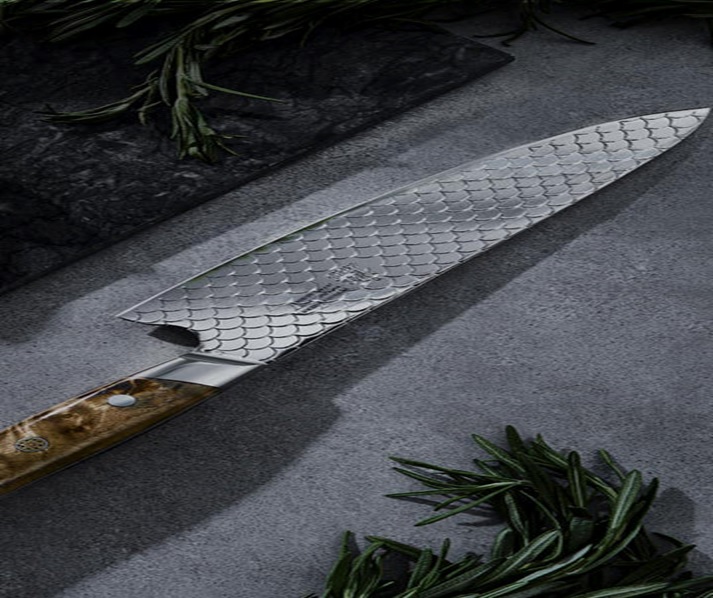
If you’ve ever deep-dived into the world of high-end cutlery, you’ve likely run across a pair of numbers that get thrown around like sports stats: 15 degrees and 20 degrees.
When talking about knife maintenance, sharpening, or buying a new blade, these numbers refer to the edge angle. But if you’re looking for sheer, laser-like cutting power, which one wins the crown?
The short answer is: 15 degrees is significantly sharper than 20 degrees.
However, in the kitchen, sharpness is only half the story. To understand why one angle might be superior for your cooking style, we need to look at the geometry of the blade, the science of the steel, and how these numbers translate to your cutting board.
The Geometry of Sharpness: Lower Means Thinner
To understand why a 15° edge is sharper, imagine looking at the cross-section of a knife blade from the front. The point where the two sides meet to form the cutting edge is called the apex.
The degree number tells you the angle at which each side of the blade is ground down to meet that apex (this is known as the “per-side” angle).

- A 15° Edge: Creates a much more acute, narrow apex. Because the edge is thinner, it encounters significantly less friction as it passes through food. It slices effortlessly, acting like a surgical scalpel.
- A 20° Edge: Creates a wider, more obtuse apex. It behaves more like a wedge. While it still cuts, it pushes the food apart with more physical resistance.
15° vs. 20°: The Ultimate Showdown
At Kyoku, we hone our flagship Japanese blades to a steep 15° angle (and sometimes even 13° depending on the series). But Western kitchen traditions have historically favored the 20° standard. Here is how they compare across the board:
The 15-Degree Edge: The Precision Scalpel
This is the hallmark of traditional Japanese cutlery. It is engineered for clean, microscopic separation of food fibers.
- Pros: Mind-blowing sharpness. It glides through delicate tomato skins, creates paper-thin onion slices, and prevents herbs from bruising.
- Cons: The edge is thinner, making it more delicate. If used incorrectly, it is more prone to chipping.
- Best For: Precision slicing, dicing vegetables, processing boneless meats, and making sushi.
The 20-Degree Edge: The Rugged Workhorse
This is the traditional standard for classic German and French chef’s knives. It is built for durability over ultimate finesse.
- Pros: Incredible durability. The wider wedge shape supports the edge, meaning it can take a beating without rolling, denting, or chipping.
- Cons: It requires more physical force to push through dense foods. It can “crush” delicate ingredients rather than slicing them cleanly.
- Best For: Hacking through joints, heavy-duty chopping, cutting open hard squash, or frozen foods.
Quick Comparison Table
| Feature | 15-Degree Edge (Japanese Style) | 20-Degree Edge (Western Style) |
| Sharpness Level | Extreme / Laser-like | Moderate / Utility |
| Friction/Resistance | Very Low | Moderate to High |
| Durability | Moderate (Requires respect) | High (Indestructible) |
| Inclusive Angle | 30° total | 40° total |
| Main Advantage | Flawless, clean cuts | Resists chipping and rolling |
Why Steel Hardness Controls the Angle
You might wonder: If 15° is sharper, why doesn’t everyone just sharpen their knives to 15 degrees?
The answer lies in the Rockwell Hardness Scale (HRC) of the steel itself.
The Rule of Steel: Softer steel cannot support a sharp 15° angle. If you sharpen a cheap, soft supermarket knife to 15 degrees, the edge will fold over or “roll” the very first time it strikes a wooden cutting board.
Western knives are typically made of softer steel (54–56 HRC), meaning they must be sharpened to 20° to stay stable.
Kyoku knives are forged from ultra-hard Japanese high-carbon super steel (60+ HRC). Because the metal is so rigid and highly structured, it can easily support a razor-thin 15° edge without buckling under pressure. It holds that hyper-sharp edge for months at a time.
Finding Your Perfect Angle
If you value the art of cooking—clean cuts, uniform dicing, and effortless prep work—transitioning to a 15-degree Japanese knife will feel like moving from a bicycle to a sports car. It completely changes your sensory relationship with ingredients. Just remember to pair it with a proper wooden or plastic cutting board to protect that beautifully acute edge.
Now that you know the structural difference between these two angles, what kind of knives are currently in your kitchen drawer—are you working with durable 20-degree workhorses, or are you ready to upgrade to a precision 15-degree Japanese blade?